Cheetah AI Case Study
Cheetah AI Case Study
Cheetah AI
Cheetah AI
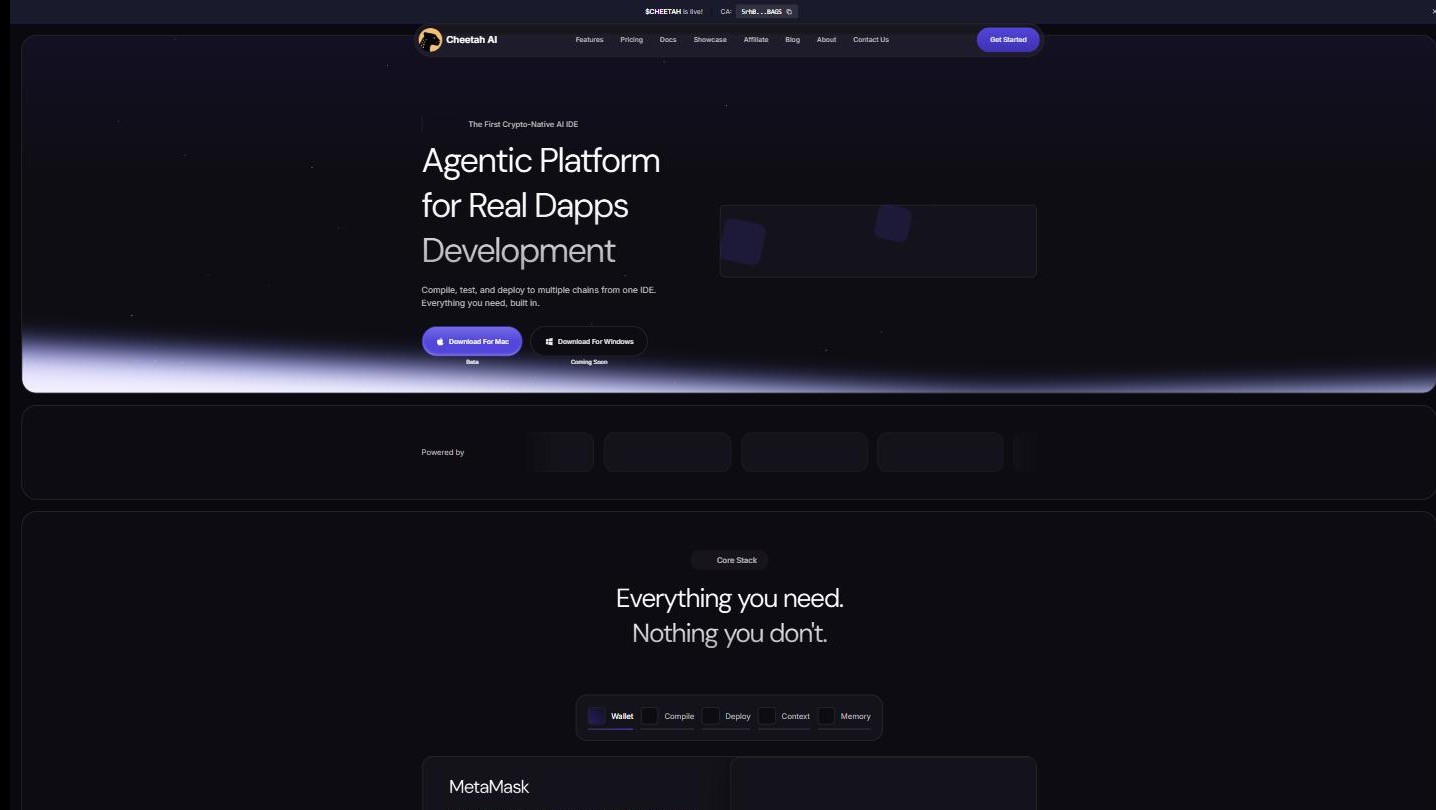
Cheetah AI is an agentic IDE I built to close the gap between writing code and watching it run. It’s a VS Code fork with Chromium and Manifest V3 extensions embedded directly inside it, so a reasoning model can edit a file, compile it, open the result in a real browser and check its own work without ever leaving the editor.
Cheetah AI is an agentic IDE I built to close the gap between writing code and watching it run. It’s a VS Code fork with Chromium and Manifest V3 extensions embedded directly inside it, so a reasoning model can edit a file, compile it, open the result in a real browser and check its own work without ever leaving the editor.
2025
Agentic IDE
Electron · TypeScript · Chromium · Manifest V3 · VS Code fork · native tool calls to Claude and GPT
Live at cheetahai.co, at 1,000+ users and $1K MRR. Its predecessor, a VS Code extension, reached 700+ users and processed 1B+ tokens with zero marketing spend.
Mission
Mission
I wanted an agent that finishes the job instead of drafting it. That meant handing the model the same two surfaces I use every day, the editor and a real browser, and letting it move between them on its own rather than stopping at a diff.
I wanted an agent that finishes the job instead of drafting it. That meant handing the model the same two surfaces I use every day, the editor and a real browser, and letting it move between them on its own rather than stopping at a diff.
Challenge
Challenge
Embedding Chromium and Manifest V3 extensions inside a VS Code fork meant reconciling two runtimes never meant to share a process. Extension APIs, sandboxing and the editor’s own Electron shell all fought each other, and every IDE and browser operation still had to become a tool call a model could reason about.
Embedding Chromium and Manifest V3 extensions inside a VS Code fork meant reconciling two runtimes never meant to share a process. Extension APIs, sandboxing and the editor’s own Electron shell all fought each other, and every IDE and browser operation still had to become a tool call a model could reason about.
Solution
Solution
I engineered a custom Electron layer with Manifest V3 support to host Chromium and browser extensions inside the fork, then exposed IDE and browser operations as native tool calls to reasoning models like Claude and GPT. That turned multi-step work into one autonomous run: write, compile, audit, deploy.
I engineered a custom Electron layer with Manifest V3 support to host Chromium and browser extensions inside the fork, then exposed IDE and browser operations as native tool calls to reasoning models like Claude and GPT. That turned multi-step work into one autonomous run: write, compile, audit, deploy.
Result
Result
Cheetah AI scaled to 1,000+ users and $1K MRR. Its predecessor, a VS Code extension, reached 700+ users and processed 1B+ tokens with zero marketing spend, which is what convinced me the full IDE was worth building.
Cheetah AI scaled to 1,000+ users and $1K MRR. Its predecessor, a VS Code extension, reached 700+ users and processed 1B+ tokens with zero marketing spend, which is what convinced me the full IDE was worth building.